

Catamaran Covers
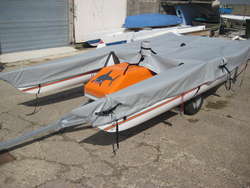
Browse our full range of custom-fit catamaran covers, manufactured in the UK from heavy-duty 460 GSM double-sided PVC. Each cover is designed to the exact dimensions of your catamaran class, with reinforced mast and shroud areas, deep-sided hull protection and snap-together fastenings for a secure, reliable fit. Select your class below to find the right cover for your boat.



Why Choose Sail Register Catamaran Covers?
Catamarans spend much of their time on trailers, exposed to wind, rain and UV light between sailing sessions. A well-fitting cover is one of the most effective ways to protect your boat from the elements and keep it ready to sail at short notice.
At Sail Register, we design and manufacture catamaran covers at our workshop in Market Rasen, Lincolnshire. Every cover is built to the specific measurements of each catamaran class, so you get a precise fit rather than a generic shape that leaves gaps or pools water. We have spent many years refining our patterns across the full range of popular catamaran classes, from the Dart 12 through to the F18 and Tornado.
Key Features
- Reinforced mast and shroud areas to resist wear at high-stress points
- Deep-sided design that extends down to protect both hulls from UV damage
- Central halyard lifting point to create a ridge for effective water drainage
- Webbing draw around hulls for extra security during towing and storage
- Snap-together fastenings throughout for a tight, secure fit
- Easy on and off. Fit it, clip it and go
460 GSM Double-Sided PVC
All of our catamaran covers are made from 460 GSM double-sided PVC as standard. This is a heavy-duty, wipe-clean material that stands up to the demands of regular towing, outdoor storage and the general wear that comes with catamaran sailing. The double-sided construction means both the outer face and the inner lining are coated, which helps prevent moisture from sitting against your hulls and trampoline.
PVC is naturally resistant to UV degradation, mildew and salt water, making it well suited to boats that are kept outdoors for extended periods. The 460 GSM weight strikes a good balance between durability and ease of handling. It is robust enough to withstand high winds on a trailer without flapping loose, while still being light enough to fold and store when you are on the water.
If you have specific material requirements or would prefer an alternative fabric, please get in touch and we will be happy to provide a quote.
Catamaran Classes We Cover
We currently hold patterns for 28 catamaran classes. Select your class from the dropdown above to view pricing and add a cover to your basket. Our range includes:
- Dart range: Dart 12, Dart 15, Dart 16, Dart 18, Dart 20
- Hobie range: Hobie 14, Hobie 15, Hobie 16, Hobie 17, Hobie 18, Hobie Dragoon, Hobie Twixxy
- Nacra range: Nacra 5, Nacra 5.2, Nacra 5.7
- F18 range: F-18, F18 Infusion, F18 Shockwave
- Hurricane range: Hurricane 4.9, Hurricane 5.9
- Other classes: A-Class, Catapult, Inter 20, Shadow, Shearwater, Spitfire, Tornado, Unicorn
Boat Not Listed?
Our range is always expanding. If your catamaran is not listed above, we can still make a cover for you. All we need are the measurements of your boat and any specific requirements you may have. We regularly add new classes based on customer requests, so there is a good chance we can help.
Visit our bespoke covers page to fill out a measurement form, or contact us directly on 01673 849893 or at info@sailregister.co.uk. We also offer trampoline covers as a simpler, lower-cost option for boats that are stored under hard cover or in a dinghy park.
Looking After Your Catamaran Cover
PVC covers require very little maintenance. A wipe down with warm soapy water after use in salt water will help keep the material in good condition. Avoid using solvents or abrasive cleaners, as these can damage the PVC coating over time.
When fitting your cover, make sure the halyard lifting point is raised to create a central ridge. This allows rainwater to run off rather than pooling in the centre, which adds unnecessary weight and can stretch the material. Ensure all snap fastenings are clipped securely before towing, and check the webbing draw is pulled tight around both hulls.